How to Shut Off Your Water Main in an Emergency
In this article
Water running right now? Make one call in ten seconds. If a single fixture is the problem — an overflowing toilet, a sink spraying — turn the small valve on the pipe feeding it, not the whole house. If water is pouring from a burst pipe, a failed supply line, or somewhere you can’t pin down, shut the main. The main stops every tap, toilet, and hose bib at once. Find it, turn it until it stops, then open a low faucet to bleed the pressure.
Stop the water now: the 10-second decision
Ask one thing: is the water coming from one spot, or everywhere?
- One fixture — a toilet, a faucet, the washer hookup. Close that fixture’s own valve (see the angle stop section below). The rest of the house keeps water.
- A burst pipe, a soaked ceiling, water you can’t trace, or several fixtures at once — go straight for the main. A failed supply line can put a lot of water on the floor fast, so every second counts.
Staying at the fixture has a real upside: the house keeps water, the heater stays full, and you skip refilling every line later. Reach for the main only when you can’t isolate the source — and when in doubt, shut it; you can always turn it back on.
Where your main shutoff valve hides
The main shutoff sits where your home’s water supply comes in from the street, so trace the pipe back from the meter. Common spots:
- The basement or crawlspace wall facing the street.
- A utility room, laundry room, or garage.
- Right near the water heater, since that line is already indoors.
- In a slab-foundation home, a closet or under the kitchen sink.
- An outdoor box near the water meter at the curb.
The meter is your best landmark; the house-side shutoff usually sits close to it.
Renters, condos, and shared mains
Rent, or live in a condo or multi-unit building? You may not have your own main — just fixture angle stops, with the building main locked in a shared mechanical room. Right now: shut what you can at the fixture, mop up, and call your landlord, property manager, or building emergency line, since they control the shared valve. Later, ask where the unit shutoff and building main are, and whether you’re allowed to touch them.
How to actually turn it off
- Confirm it’s the main. It should control the whole house, not one sink. Unsure? Trace the pipe to where it comes into the home.
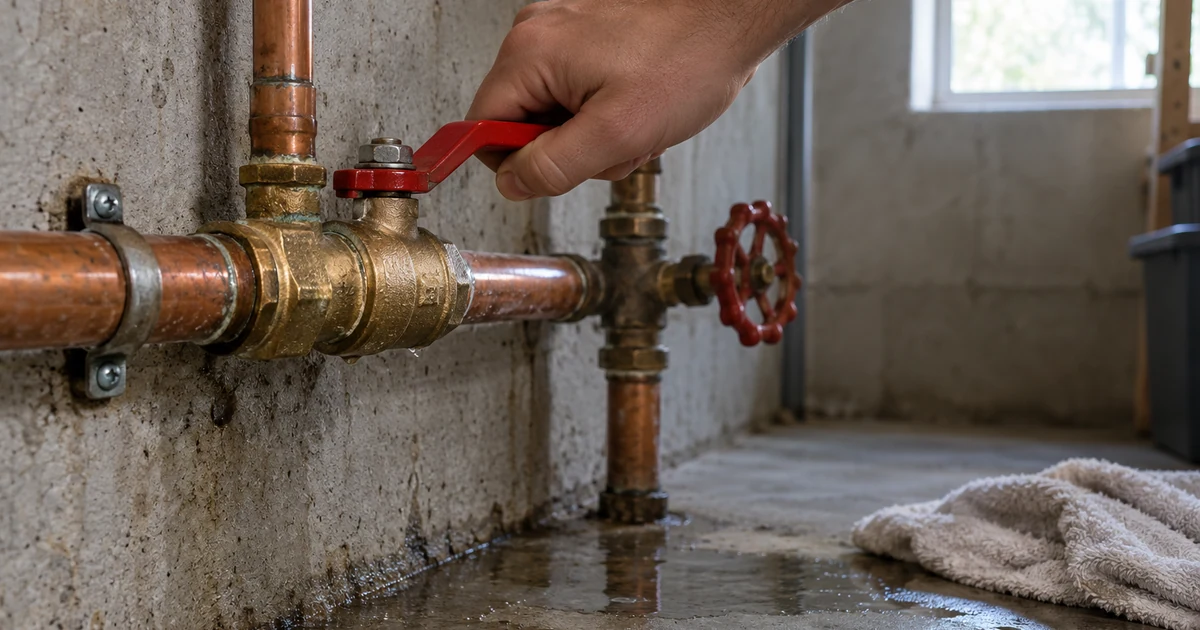
- Identify the valve. A round wheel = a gate valve. A straight lever = a ball valve.
- Turn a gate valve clockwise (righty-tighty) until the wheel stops.
- Turn a ball valve a quarter turn until the handle sits crosswise to the pipe.
- Stop at firm resistance. You’ll feel the valve seat when it’s shut. Don’t force it past that.
- Open a low faucet — a basement sink or outside hose bib — to drain the remaining pressure. A few seconds of trickle is normal as the lines empty.
Fixture shutoffs: the smaller valve you may want instead
Most fixtures have their own shutoff — an angle stop — on the supply line just below them. Look under sinks and behind the toilet (a small oval handle on the wall). A running toilet or dripping faucet is almost always a fixture job: close its angle stop and the rest of the house stays live. Save the main for what you can’t isolate.
When the main valve is stuck or won’t turn
Stuck valves are common — years of rust, hard-water scale, or a handle frozen in place. Don’t reach for a long wrench or cheater bar. Too much force snaps the handle or cracks the body, and now you’ve turned a leak into a flood. Instead:
- See whether a fixture angle stop can isolate the problem.
- If nothing works, call your water utility — they can shut the curb stop at the street.
- Once the crisis passes, have the stuck valve replaced.
The street curb stop: call the utility first
When the indoor valve fails or you can’t find one, there is still a valve outside: the curb stop, usually in a box with a lid near the water meter at the curb or sidewalk. In many places that valve belongs to the water utility, not to you, and it can be old and easy to break. So the safe move is to call your water utility’s emergency line and ask them to shut it. Some utilities let homeowners turn it with a meter key (a long T-handle tool); if yours does, it’s usually a quarter turn so the slot crosses the pipe. Ask before you need it, not with water on the floor.
Use the meter to check your work: with every fixture off, look at the meter’s small leak indicator (often a little triangle or dial). If it’s still turning, water is still moving somewhere. If it stops, your shutoff worked.
After the water is off: drain, power, safety, photos
Shutting the main buys time; it doesn’t fix the cause. Protect the house while you line up a repair.
- Open the lowest faucet to drain pressure and standing water.
- Turn off the water heater if the supply will be off a while — gas to pilot or vacation, electric at the circuit breaker. An electric element can burn out if it runs without water, which heater makers warn about in their manuals.
- Mop standing water with towels, buckets, or a wet vac where it’s safe.
- Stay clear of water near outlets or electrical gear until it’s checked — kill that circuit at the breaker first.
- Take photos and video of the damage for your insurance claim before cleanup.
- Trace the real source — fixture, supply line, exposed pipe, or heater — so you can describe it to a plumber.
Turning the water back on
Once the repair’s done, reopen slowly. Open a faucet on the top floor first so trapped air has an escape. Crack the main valve part-way, let water climb through the system, then open it fully. Open it all at once and moving water slams into the closed taps — that bang in the walls is water hammer, and it loosens joints over time. Let the high faucet run clear, then work down, closing each tap once it bleeds steady.
Gate vs. ball valves, and upgrading an old one
If your main is an old gate valve, know its weakness. The lines feeding it shed minerals and rust that pack around the internal gate, so it refuses to seal or seizes outright right when you need it. Ball valves are simpler and far more reliable, and the quarter-turn handle shows at a glance whether it’s open or shut. That reliability is why plumbers now put ball valves on the main.
| Attribute | Gate valve (round wheel) | Ball valve (lever) |
|---|---|---|
| How you turn it | Several full turns clockwise | One quarter turn |
| Reliability over time | Prone to seizing and corrosion | Very reliable |
| Open/closed at a glance | Hard to tell | Obvious from handle |
| Best for a main shutoff | Replace when you can | Recommended |
Scroll sideways to see the whole table.
If yours is an aging gate valve, put “upgrade to a ball valve” on the list for your next plumbing visit — a quick job on its own, though it costs more if the line needs soldering or the water has to be shut at the curb first.
Smart shutoff systems and when to call a plumber
A smart water shutoff system mounts on the main line, senses abnormal flow or a leak, and closes the valve on its own, with no handle to find. Budget for the hardware plus professional installation on the main, and remember any device can misread or lose power. It’s a safety net, not a substitute for knowing where your manual valve is.
For the repair, line up a pro before you need one. Walk through the questions to ask before hiring a plumber so an emergency call doesn’t leave you overcharged, and learn how to check if a plumber is licensed and insured through your state board. If you’re in Phoenix, Chattanooga, or Billings, FairPipes is a free directory where you can read what past customers said — the good and the bad side by side — before you call.
Do this today, before you need it
Five quiet minutes now saves a soaked floor later:
- Find your main shutoff and confirm it controls the whole house.
- Tag it with a bright label and show everyone in the household.
- Test it gently once — off, confirm a faucet stops, back on — so you know it moves.
- Locate your fixture angle stops and meter box too.
- In a cold climate, this is also your frozen-pipe plan: before you leave the house empty in winter, shut the main and drain the lines so a burst pipe can’t flood it.
Questions and answers
Can I turn off the main water line to my house?
Yes. Every homeowner can shut the main valve inside the house or where the line enters it, and it's the right move for a burst pipe or a leak you can't isolate. Close a round wheel valve clockwise until it stops, or flip a lever valve a quarter turn so the handle sits across the pipe. If that valve is stuck or missing, your water utility can shut the curb stop at the street.
Where do I find the main water shut-off valve?
Follow the main water line to where it enters the house. In homes with a basement or crawlspace it's usually on the wall facing the street; otherwise check the utility room, garage, near the water heater, a closet, or under the kitchen sink in slab homes. The water meter is a landmark — the house-side shutoff often sits right near it, sometimes in an outdoor box by the curb.
Does every house have a water shut-off valve?
Almost always, but it isn't always easy to reach or in working order. Older homes may have a corroded valve that no longer seals, and some slab homes hide it in an odd spot. If you can't find an indoor valve, there is still a curb stop near the meter outside; call your water utility and ask them to shut it.
How do I replace a main water valve?
Replacing a main shutoff means cutting into the main supply line, so most people hire a licensed plumber. The water has to be off at the curb first, which often means a call to the utility. A common upgrade is swapping an old gate valve for a quarter-turn ball valve, which is far more reliable. Treat it as a planned job, not an emergency fix.
How do I turn off water to the house from outside?
The outdoor valve is the curb stop, in a box near the water meter at the curb or sidewalk. In many places it belongs to the water utility, so call them and ask them to shut it. If your utility allows homeowners to use it, it usually takes a meter key (a long T-handle tool) and a quarter turn so the slot crosses the pipe.
Which way do I turn the valve to shut the water off?
A round wheel (gate) valve turns clockwise — righty-tighty — until it stops. A lever (ball) valve needs only a quarter turn until the handle sits crosswise to the pipe. Stop when you feel firm resistance; never muscle it past that point.
How do I turn off water to the house without a tool?
Indoor main valves and fixture angle stops are hand-operated, so you need no tool at all — just grip and turn. A stubborn wheel may turn easier with gloves for grip. The curb stop outside is the exception: it usually needs a meter key and may belong to the utility, so call them rather than prying at the box.
My main valve is stuck — what should I do?
Stop pulling on it. A corroded or seized valve can snap at the handle or crack the body, turning a leak into a flood. Try isolating the problem at a fixture angle stop instead, or call the utility to shut the curb stop. Once the emergency is over, have a plumber replace the stuck valve with a ball valve.
Do I need to turn off the water heater when I shut the main?
If the supply is off for more than a short while, yes. An electric heater can burn out its element if it runs dry, so switch it off at the circuit breaker. A gas heater should be turned to "pilot" or "vacation." Then open a low faucet to drain the lines, which also protects against frozen, bursting pipes if you're leaving the house cold.
When should I call an emergency plumber instead of handling it myself?
Call right away if a pipe has burst, water keeps flowing after you've shut off, you can't find the valve, or a major leak is flooding the house. Also call if the shutoff is stuck and no fixture valve can isolate the problem. Shutting the main buys time but never fixes the cause, so a permanent repair still needs a pro.
Check a business before you call
Read what other customers say about a business, complaints and praise side by side.
Search for a businessKeep reading
Confirm a plumber is licensed, bonded, and insured in about 10 minutes: look up the state board, call the insurer, and verify the bond before work.
10-minute read
A five-minute phone script for hiring a plumber: license, insurance, flat-rate pricing, warranty, and the answers that mean hang up.
11-minute read